Ginto at Pilak banner
Montessori-Informed Filipino Literacy Progression

Tunog at Pantig Training Program

A Sound-and-Syllable Filipino Reading and Writing Pathway for Young Learners

Tunog at Pantig means sounds and syllables, is a developmental literacy program that helps children build a strong foundation in Filipino reading and writing through sounds and syllables, with a pathway that can grow toward grammar awareness, parts of speech, and sentence analysis.

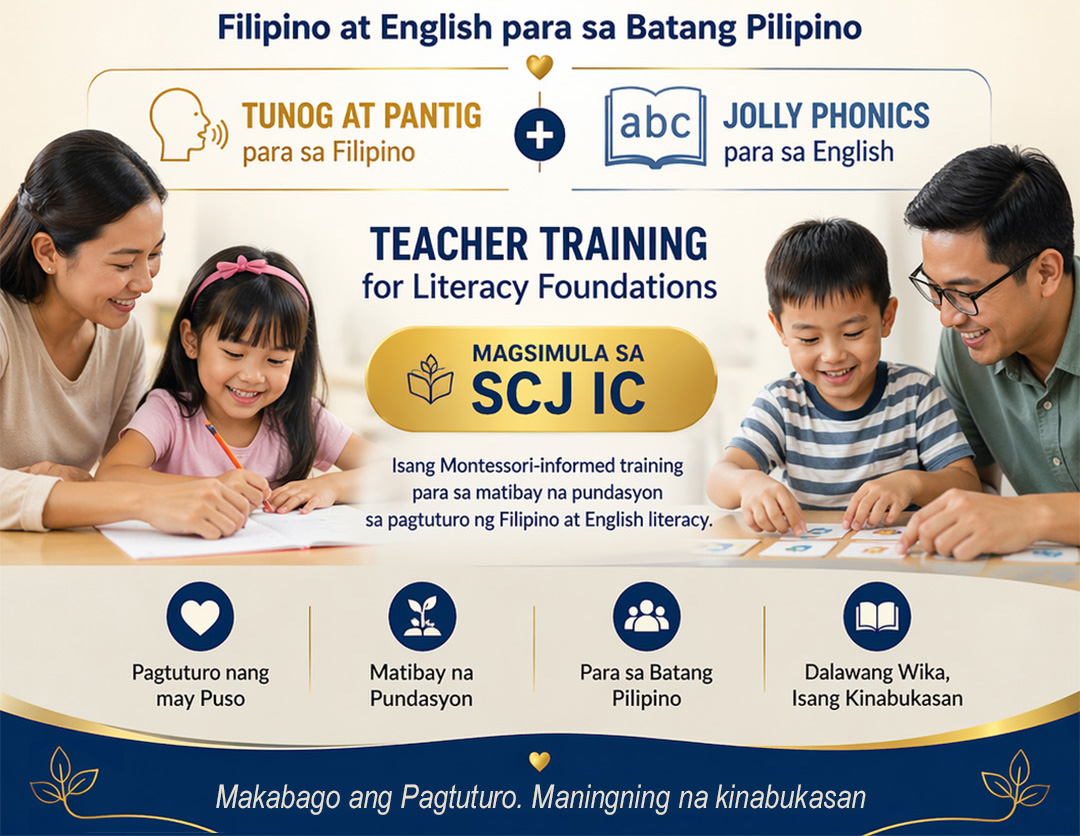
Prerequisite: The recommended entry point before taking the full Tunog at Pantig Training Program is the Speak and Code Juku (SCJ) / Literacy Foundations (Introductory Course), a 2-day bootcamp in Montessori language foundations and systematic synthetic phonics through Jolly Phonics.

Designed for teachers, school owners, parents, home tutors, and tutorial centers who want a clear, structured, and community-empowering Filipino literacy framework.

The program is also designed as a social enterprise sustainability pathway that empowers parents, home tutors, tutorial centers, and small school owners through structured literacy training and capacity-building.

Program Highlights
  • Stage 0 to Stage 5 developmental literacy framework
  • Montessori-informed and Filipino-adapted structure
  • Teacher training, parent empowerment, and tutorial-center pathways
  • Stage 0 includes sandpaper letters, movable alphabet, metal insets, and cutting progression, beads and pompons and more. 
  • Stage 1 focuses on phonemes, pantig, blending, dictation, and decoding-to-writing
  • Uses a uniquely tailored Filipino pedagogy built around the 22 Filipino letter sounds and syllable patterns
  • Built with OFW experience in Japan and designed as an OFW reintegration-ready pathway
  • Recommended prerequisite: SCJ IC / Literacy Foundations (Introductory Course)
Proponents:

Good Shepherd Montessori School of Pasig and Seels Teachers Academy

Jointly developed as a practical response to foundational Filipino literacy needs.

Why this program matters

Tunog at Pantig is built as more than a reading module. It is a full literacy progression that moves from readiness to decoding, then to grammar awareness, parts of speech, and sentence understanding. It is designed to help educators and families support learners with a step-by-step, developmentally sound Filipino literacy system. Its pedagogy is Montessori-informed, Filipino-adapted, and developmentally sequenced, with a structured introduction to the 22 Filipino letter sounds and syllable patterns beginning as early as ages 2.5–4 through Pre–Tunog at Pantig. The recommended prerequisite before the full training is the SCJ IC / Literacy Foundations (Introductory Course), which serves as a foundational Digital Montessori bootcamp.

Stage 0
Pre-writing and sound readiness for ages 2.5–4
Stage 1
Phonemes, pantig, blending, dictation, writing
Stage 3–5
Grammar symbols, parts of speech, sentence analysis
Community
Teachers, parents, tutors, and school partners
Social Enterprise Sustainability
  • Mission-driven literacy capacity-building model
  • Empowers parents, home tutors, tutorial centers, and small school owners
  • Supports quality implementation and long-term continuity
  • Builds a community-based Filipino literacy ecosystem
  • Built with OFW experience in Japan and designed as an OFW reintegration-ready pathway

From Teacher Training to Educational Ownership

Explore the companion page that shows how Tunog at Pantig can become a pathway from home tutor to tutorial center to school builder.

  • 4 growth stages from home tutorial to school pathway
  • Comparative view: Tunog at Pantig vs online teaching
  • Estimated startup cost and income progression per stage
  • Teacher entrepreneurship and social enterprise positioning
  • OFW reintegration-ready opportunities for returning Filipinos who want to build education-based livelihood
1
Developmental

Children move from readiness to decoding, then to grammar and sentence understanding in a logical sequence.

2
Montessori-Informed

The program uses sensorial and concrete tools such as sandpaper letters, movable alphabet, grammar symbols, and sentence analysis materials.

3
Filipino-Adapted

The framework is designed around Filipino sound patterns, the 22 Filipino letter sounds, pantig, word function, and sentence structure rather than direct transfer from English models.

The full literacy progression

A clear pathway from sensorial readiness to sentence analysis.

Stage 0

Pre–Tunog at Pantig

Ages 2.5–4 | Sensorial preparation for Filipino literacy and readiness for the 22 Filipino letter sounds

  • Fine motor and gross motor readiness
  • Sound exposure and sound repetition
  • Sandpaper letters and movable alphabet readiness
  • Metal insets, cutting progression, and pre-writing control
Stage 1

Tunog at Pantig

Writing-ready learners | Decoding to writing through a structured 22-letter-sound and syllable pathway

  • 2 new sounds per lesson
  • Pantig reading and controlled blending
  • Dictation, reading line, and early writing
  • No untaught sound rule in core lesson examples
Stage 2

Supplementary Borrowed-Sound Track

Additional exposure to borrowed sounds used in names and loanwords.

Stage 3

Gamit ng Salita at Simbolo ng Balarila

Grammar symbols and function of words through a Montessori-informed approach.

Stage 4

Bahagi ng Pananalita sa Filipino

Formal parts of speech classification in Filipino.

Stage 5

Pagsusuri ng Pangungusap sa Filipino

Montessori-informed sentence analysis using simuno, panaguri, pandiwa, layon, attribute, and adverbial extension.

Training program components

Designed to build literacy capacity among educators, parents, and small learning support providers.

Recommended entry point: Complete the SCJ IC / Literacy Foundations (Introductory Course) first. This 2-day Digital Montessori bootcamp is the recommended prerequisite before the full Tunog at Pantig training program.
Prerequisite Course
  • SCJ IC / Literacy Foundations (Intensive Course)
  • 2-day Digital Montessori bootcamp
  • Recommended first step before full Tunog at Pantig training
  • Builds Montessori, literacy, and implementation foundations
Teacher Training
  • Stage 0 teacher training manual and implementation guide
  • Tunog at Pantig lesson structure and sound progression
  • Grammar symbols, parts of speech, and sentence analysis orientation
Parent and Home Tutor Capacity-Building
  • Stage 0 home support understanding
  • Guided literacy support routines
  • Sound, tracing, and readiness activities at home
Tutorial Center and Small School Pathway
  • Structured literacy support model
  • Teacher workshop and implementation tools
  • Social enterprise capacity-building model

Who this program is for

The landing page can support recruitment, orientation, or partnership conversations.

Teachers

Preschool and elementary teachers who want a structured Filipino literacy sequence.

School Owners

Small school leaders who want literacy support models, staff training, and implementation pathways.

Parents

Families who want to understand readiness, early literacy support, and home-based learning guidance.

Home Tutors & Centers

Tutorial providers who want a developmental and Montessori-informed Filipino literacy framework.

Program proponents

A joint effort built on classroom teaching experience and teacher-training practice.

Good Shepherd Montessori School of Pasig

Bringing 21 years of teaching experience and on-the-ground school-based practice.

Seels Teachers Academy

Bringing 15 years of teacher training experience in Digital Montessori Education and TESOL.

What makes this different
  • Not just a reading drill, but a full literacy progression
  • Includes readiness before formal decoding
  • Builds from sound awareness to grammar and sentence meaning
  • Suitable for training ecosystems involving schools, families, tutorial support, and small school partners
  • Combines literacy intervention with community-based capacity-building and social enterprise sustainability

Frequently asked questions

No. The framework is designed for schools, tutorial centers, home tutors, and even parent-support pathways.

Stage 0 begins at ages 2.5–4 for pre-writing and sound readiness. Stage 1 begins once learners are writing-ready. Later stages cover grammar and sentence analysis.

It is Montessori-informed and Filipino-adapted. It uses Montessori-inspired sensorial, manipulative, and developmental principles while responding to Filipino sound, pantig, and sentence structure.

Yes. The recommended prerequisite is the SCJ IC / Literacy Foundations (Intensive Course), a 2-day Digital Montessori bootcamp that serves as the entry point before the full Tunog at Pantig training program.

Yes. The framework is designed for teacher training, parent orientation, tutorial-center capacity-building, and school implementation support.

Bring the Tunog at Pantig Training Program to your school, center, or community.